Teqball
Teqball is a ball sport that is played on a curved table, combining elements of football and table tennis. Back and forth, the players hit a ball with any part of the body except arms and hands. Teqball can be played between two players as a singles game or between four players as a doubles game. The game is represented at an international level by the International Teqball Federation (FITEQ). The game has attracted several world-class footballers, and after being added to the programs for the 2021 Asian Beach Games and the 2023 European Games, the sport is now aiming for Olympic inclusion
In November 2020, FITEQ was granted full membership of the Global Association of International Sports Federations (GAISF).
Playing court
The official competition size of a teqball court is a minimum of 12 meters (39 ft) wide by a minimum of 16 meters (52 ft) long by a minimum of 7 meters (23 ft) high. The court must be rectangular and marked with surrounds with a minimum height of 500 mm (20 in) and a maximum height of 1,500 mm (59 in). The Teq table is located in the exact center of the court, with the net positioned parallel to the perimeters of the shorter sides.
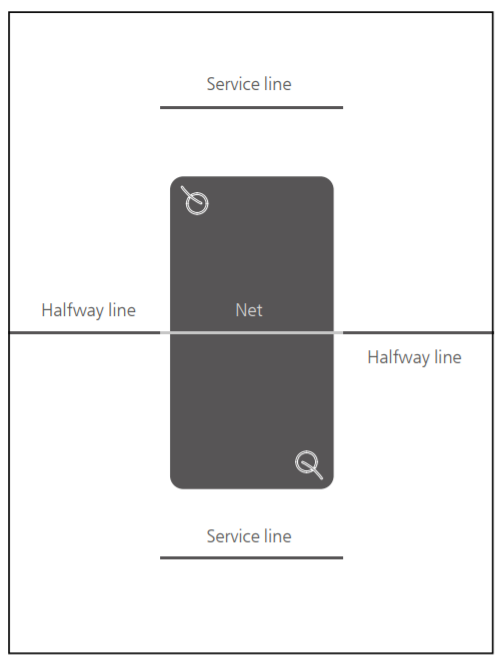
Teq table
The curved table measures 3 meters (9.8 ft) in length and is 1.7 m (5 ft 7 in) wide with the highest point at 0.76 m (2 ft 6 in) in the middle of the playing surface, where the net with a height of 14 cm (5.5 in) is installed, separating the surface into two parts. The two outer edges of the width are 56.5 cm (22.2 in) above the ground.
Ball
The ball is spherical and must be made of leather or another suitable material, featuring a latex bladder with a butyl valve. The ball is a regular size-5 football, but kept at a lower pressure [between 0.3 and 0.5 atm (30 and 51 kPa; 4.4 and 7.3 psi)] than it would be for a football.
History Evolution
Teqball is a modern sport that does not have a long history. It was invented in 2014 in Hungary by three football enthusiasts: former professional player Gábor Borsányi, sex industry and political entrepreneur György Gattyán, and computer scientist Viktor Huszár. The creative idea came from Borsányi, who used to play football on a table tennis table. The horizontal design of the table often meant the ball often not bounce to the players, so this game was not enjoyable. Borsányi thought that if the table were bent, the arched surface could help the ball bounce to the foot. After several years of development with Huszár, the first teqball table was made in 2014.
According to Murányi Gergely of FITEQ, “We called it teqball because you need technique to play the game and you play it with a regular soccer ball.”
The sport was officially presented in Budapest on 18 October 2016 by Brazilian ex-football player Ronaldinho, one of the ambassadors of teqball.
Modern-day relevance
Standard soccer matches need many people, a large field, and a lot of time for each game.
Teqball condenses everything into a small set of court and skill, including first touch and control.
It also provides a way to let soccer players showcase their skills of ball control, which may not be significant in standard games.
Role in society
Teqball became the world’s fastest-recognized sport in August 2018, when its highest governing body, FITEQ, was officially recognized by the Olympic Committee of Asia (OCA). In June 2019, it was formally recognized by the Association of National Olympic Committees of Africa (ANOCA).